Repositioning the Wheel
In the first-season finale of Mad Men, ad man Don Draper pitches Kodak on how he would approach the advertising for their newest product, a slide projector with a rotating tray. The Kodak engineers have been calling it “the Wheel.” It’s a fine, accurate name for a device that is round and turns. But Draper sees something else.
He dims the lights and begins clicking through the slides that he has pre-loaded into the device—photos of his own family. As he advances each slide, he talks about the power of memory, nostalgia, and the shared human desire to revisit the past. Draper argues the technology Kodak is offering is actually a time machine. “It takes us to a place we ache to go again.” Then he makes the famous proclamation. “It’s not called the Wheel. It’s called a Carousel. It lets us travel the way a child travels: round and around and back home again, to a place where we know we are loved.” Though fictitious, Draper’s pitch is a prime example of the marketing art and science of positioning.
What Positioning Actually Is
Al Ries and Jack Trout popularized the concept of positioning in their 1981 book Positioning: The Battle for Your Mind.
“Positioning is not what you do to a product. Positioning is what you do to the mind of the prospect.”
Trout and Ries describe positioning as a framing practice—closely related to the anchoring effect that psychologists study. The basic move is to take connections that already exist in the mind and attach them to the thing you’re positioning. Politics offers a vivid example, since positioning is central to campaign strategy. In the 1990s, opponents of the federal estate tax began calling it the death tax—a fair enough description, since the tax is levied when someone dies and their estate passes to heirs. But that single relabeling reframed the whole debate, and voter sentiment swung from mild support to widespread opposition. Same tax. Different name. Different place in the mind.
Every day, thousands of messages compete for a sliver of each person’s attention, and the mind rejects most of them. Ries and Trout argued that the real battleground is the prospect’s mind. The products and brands that win are the ones that are easily recalled and successfully claim a distinct piece of mental territory.
Positioning is also an exercise in making a competitive choice. You decide what you want customers to associate with your product and also whom you want to be compared against. Positioning defines the frame of reference for competition. It determines where you will fight, where you will not, and what trade-offs you are willing to make in order to occupy a distinct place in the market.
IKEA: A Different Place to Stand
For most of the twentieth century, buying furniture forced consumers into a cheap vs. good paradigm. Good furniture was expensive, bought rarely, sold by a salesperson on a showroom floor, and delivered weeks later by truck. Cheap furniture existed, but most of it was poorly designed. IKEA was founded in Sweden in 1943 by a seventeen-year-old named Ingvar Kamprad, who decided not to compete inside that trade-off. He decided to stake out a competitive position that was both affordable and stylish.
IKEA’s Strategic Positioning
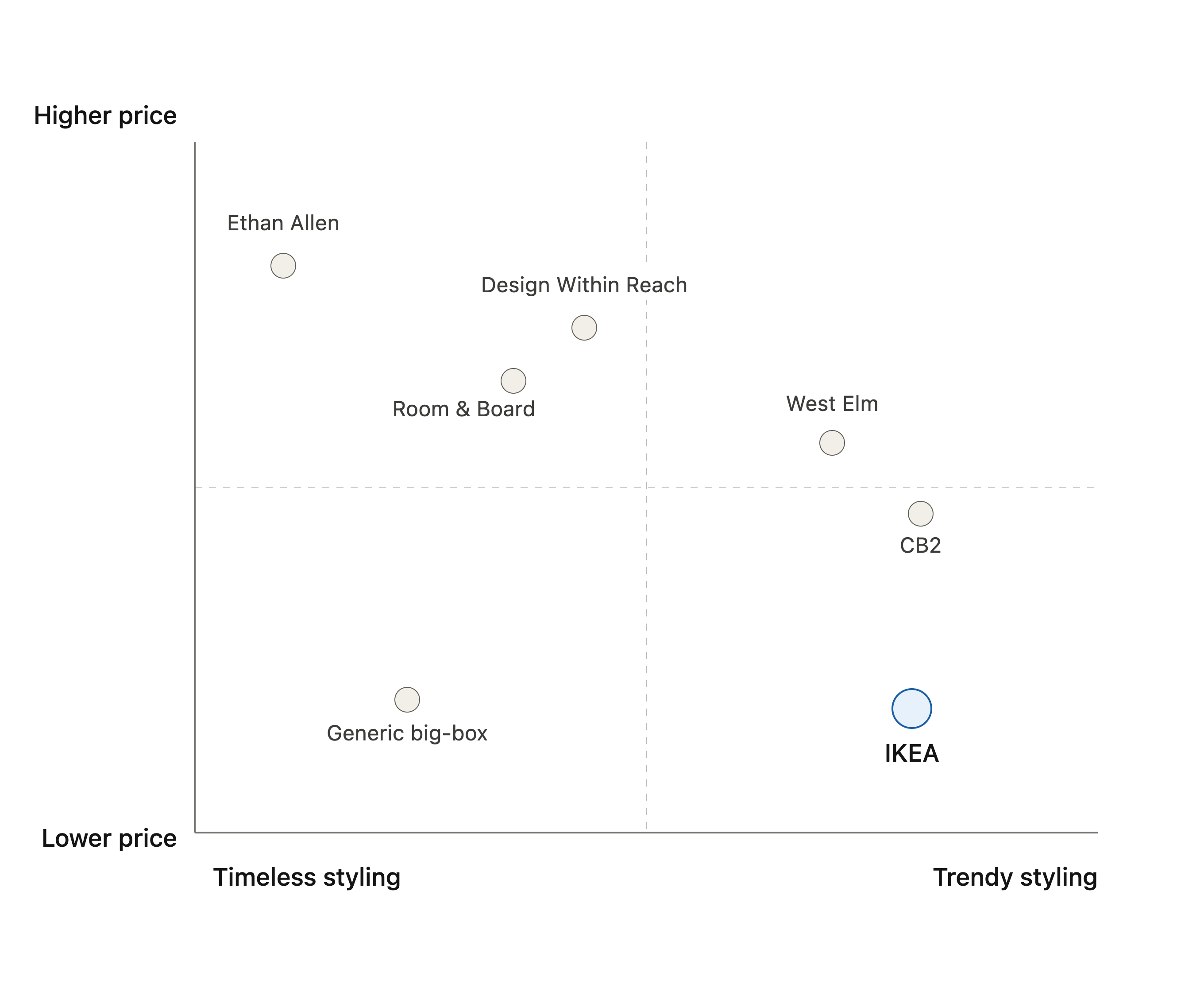
IKEA named their competitive position as democratic design—a positioning around the idea that good design shouldn’t be a luxury for the wealthy but something available to almost everyone. The trade-off was durability and service. Most IKEA furniture is made from particle board or other materials less expensive than fine hardwoods. Also, buyers of IKEA furniture have to assemble the pieces themselves. But for the target audience IKEA markets to, these were features rather than bugs. The furniture you buy for your college dorm or the apartment you rent your first year out of college doesn’t need to be durable. At a lower price point you are perfectly fine giving or throwing it away when you’re done with it.
The low price stops feeling like a compromise and starts feeling like a clever secret you’re in on. Research has shown that people grow more attached to things they build, so all that time with an allen wrench emotionally invests the customer in the result. And IKEA is known for setting the target price first and then designing the product to hit it. Price is first question, not the last.
Positioning is always relative. You are defined by who you stand next to. IKEA’s position is sharpest when you see who it is not near. Map the furniture world on two axes, price and styling, and the players sort themselves out. In the expensive, timeless corner sit the heirloom names: Ethan Allen with its traditional hardwood, Design Within Reach and Room & Board with their enduring modern classics—furniture you buy once and keep. Up the trendy side, more affordable but still a step above IKEA, sit design-forward retailers like West Elm and CB2. Down in the plain, cheap corner is the generic big-box furniture nobody forms an opinion about. And then there’s the quadrant almost no one else seems to profitably occupy—affordable and of-the-moment—where IKEA stands nearly alone.
Positioning and Customer Expectations
When you position a product, you are setting an expectation. Every claim in a position is a promise about what the customer will get. And the customer, holding that expectation, then goes and experiences the actual product. Whether they walk away happy depends on the relationship between the two:
\[\text{Satisfaction} = \frac{\text{Experiences}}{\text{Expectations}}\]
This formula captures something a lot of clever marketers learn the hard way. You can set a thrilling expectation and fail. If the experience doesn’t clear the bar you raised, you will have dissatisfied customers and the seeds of a reputation problem. In fact you can lose worse than if you’d promised nothing, because you didn’t meet or exceed expectations.
Satisfaction rises when the experience gets better. It also rises when the expectation is set lower. Most people only ever pull the top lever and promise more. Disciplined companies sometimes mind the denominator. They set an expectation specifically so that they know they can beat it consistently. A modest promise spectacularly kept beats a grand promise barely met.
IKEA provides a useful example of expectation management. The company does not promise heirloom quality furniture that will last generations. Instead, it promises stylish, functional furniture at a price that makes replacement and reinvention easy. Customers understand the trade-off before they buy, so the experience generally matches the expectation.
This alignment between expectation and experience is one reason IKEA’s position is so durable. The low price feels less like a compromise and more like a smart choice. Customers are not disappointed that the furniture isn’t permanent because permanence was never part of the promise. In fact, if the furniture was more expensive, they might feel compelled to hold onto it longer to maximize their return on investment.
The brand ran a famous “Lamp” commercial, created by Crispin, Porter + Bogusky and directed by Spike Jonze, in September, 2002. In it, we watch an old lamp set out on the curb in the rain, the music swelling, the framing begging us to feel sorry for the discarded thing that looks similar to the lovable Pixar icon. Then a man with a European accent appears and tells us we are being ridiculous: “Many of you feel bad for this lamp … that is because you crazy. It has no feelings. And the new one is much better.” This is IKEA’s positioning in action through clever communications.
Positioning Statements
Positioning lives in the customer’s mind, but you don’t get to leave it to chance. You decide, on purpose, what position you are going to fight for. The tool for pinning that down is the positioning statement. It isn’t ad copy and it isn’t a slogan. It’s an internal planning sentence that forces you to commit.
Each component serves a purpose. The target customer identifies whose mind you are trying to occupy. The need defines the problem you solve. The category determines the frame of comparison. The benefit explains why the offering matters, while the differentiator explains why customers should choose it over the alternatives. Together, these elements force clarity about both the customer and the competition.
For (target customer) who (need or opportunity), (product) is a (category) that (key benefit). Unlike (primary alternative), (product) (key differentiator / reason to believe).
Filled in for IKEA:
For budget-conscious people setting up a home who want it to look good without spending a fortune, IKEA is a home-furnishings brand that makes well-designed furniture affordable for nearly everyone. Unlike traditional furniture stores, IKEA keeps prices low through flat-pack, self-service, and self-assembly—savings you can see and verify for yourself.
Look at the “is a” line, because it names the category. “A home-furnishings brand” built on democratic design, not “a cheap furniture store” and not “a luxury design house.” Get that line wrong and everything downstream is standing on the wrong shelf, measured against the wrong rivals. Often the single most consequential word in the whole statement is the category you claim, because it decides who you stand next to in the customer’s mind.
And notice what IKEA had to give up to own its slot. It cannot also be the brand of furniture you pass down for generations. It chose not to be something. Michael Porter is famous for declaring that competitive strategy is deciding what not to do. Good positioning follows this advice.
Positioning Statements and Value Propositions
If you’ve studied value propositions, this framework may look familiar. That’s because the two ideas are closely related. Both identify a customer and a superior benefit.
The difference is one of emphasis. A value proposition focuses on the value customers receive. It answers the question: Why should someone choose this product? Positioning focuses on the meaning customers attach to the product relative to alternatives. It answers a different question: What idea do we want to own in the customer’s mind? It provides a reason to believe.
In practice, the two frameworks often overlap. Many modern positioning statements contain a value proposition within them. The key distinction is that positioning always suggests a central argument that persuades us and sticks in our mind.
Further Reading
Ries, A., & Trout, J. (2001). Positioning: The Battle for Your Mind (20th anniversary ed.). McGraw-Hill. The founding text. The examples are dated; the central idea—that positioning happens in the prospect’s mind, not in the product—has aged perfectly.
Trout, J., & Ries, A. (1986). Marketing Warfare. McGraw-Hill. Where positioning grows up into competitive strategy: choosing where to fight, whom to fight, and where not to.
Trout, J., & Rivkin, S. (2008). Differentiate or Die: Survival in Our Era of Killer Competition (2nd ed.). Wiley. Trout’s blunt later argument for why owning a distinct position is a matter of survival, not preference.
Moon, Y. (2005). “Break Free from the Product Life Cycle.” Harvard Business Review. Introduces reverse, breakaway, and stealth positioning—including the “breakaway” move of placing a product in a different category, the same shelf-change instinct behind both stories in this note.