The Job to be Done
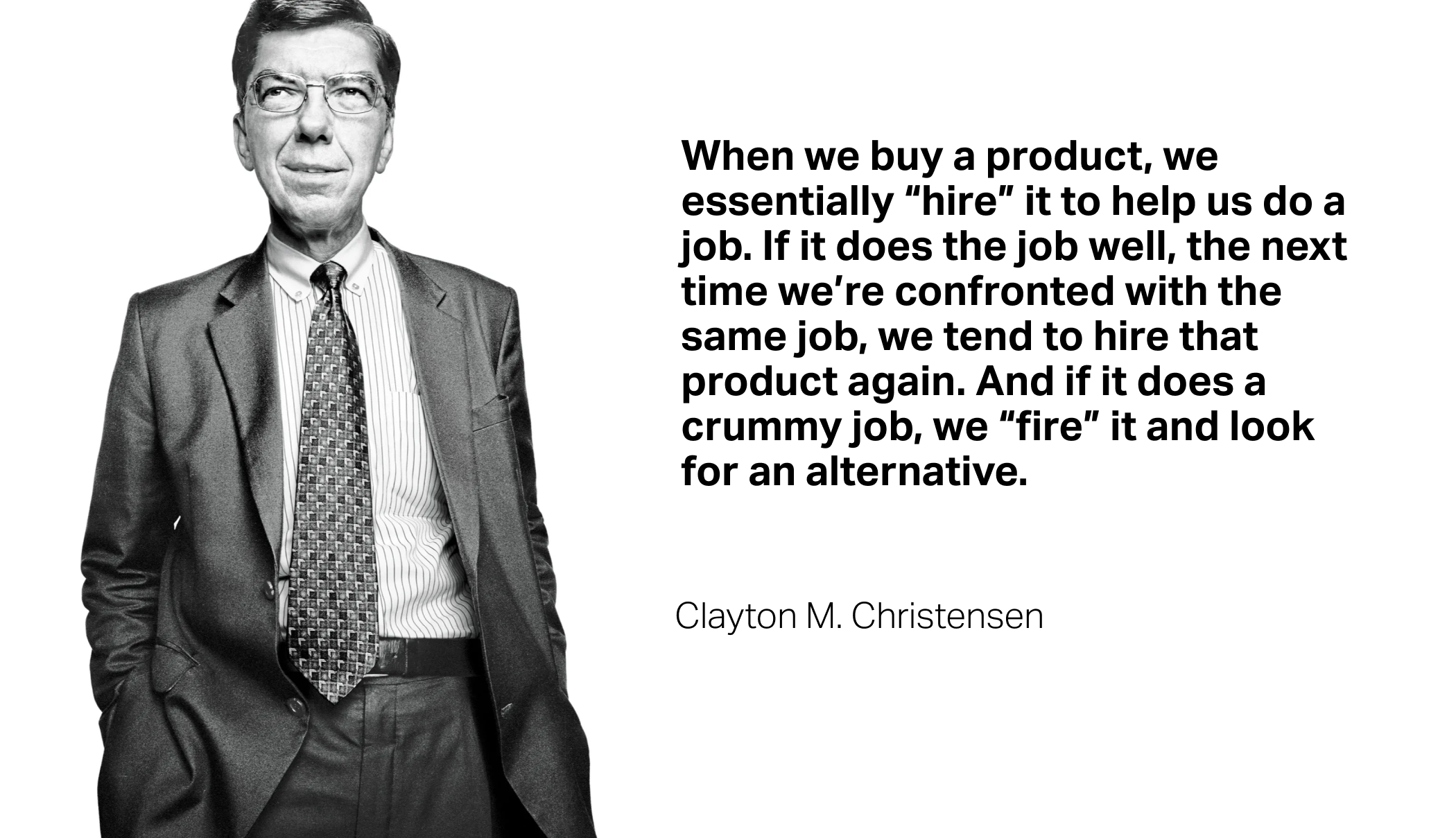
People buy products to get a job done. This simple idea was the basis of an important framework established by a legendary Harvard Business School professor named Clayton Christensen. Christensen believed that instead of asking what features we should build, we need to ask, “what job is the customer hiring this product to do?” It’s known as the Jobs to be Done (JTBD) framework, and it’s a critical perspective that can help us design and build profitable products.
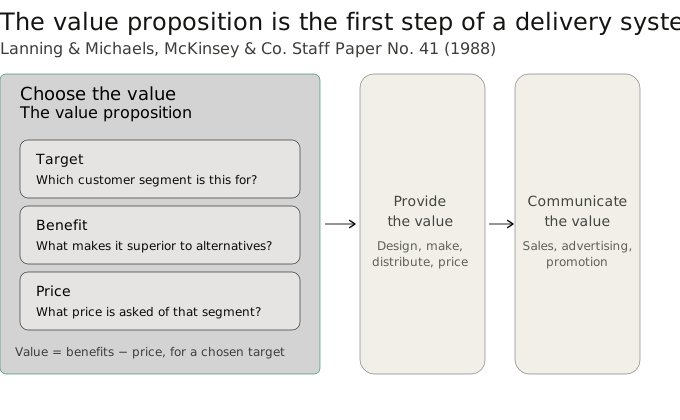
A value proposition is the simplest framework you can use to develop products that align with the JTBD framework. A business is essentially a value delivery system. Products (or offerings) are the output of this system. Successful companies begin by choosing the value to be delivered (or the job the customer hires the product to help with). The next step is delivering the value, meaning the specific and distinctive benefits that get the job done better than alternatives, according to our preferences. Finally, companies communicate the value. This is the part of marketing most folks naturally think of because it is linked to advertising and promotion. But marketing is really about all three. You purposefully choose what value to deliver and then you figure out how to communicate it.
Wanted: Stylish Thirst Trap
Definitions are forgettable, so let’s focus on a product you probably know better than you’d like to admit: the Stanley Quencher. This 40-ounce tumbler with handle and built-in straw has become ubiquitous—the source of endless TikTok shorts and a slew of competitive knock-offs.
Here’s something you maybe didn’t know: Stanley almost threw the Quencher in the trash.
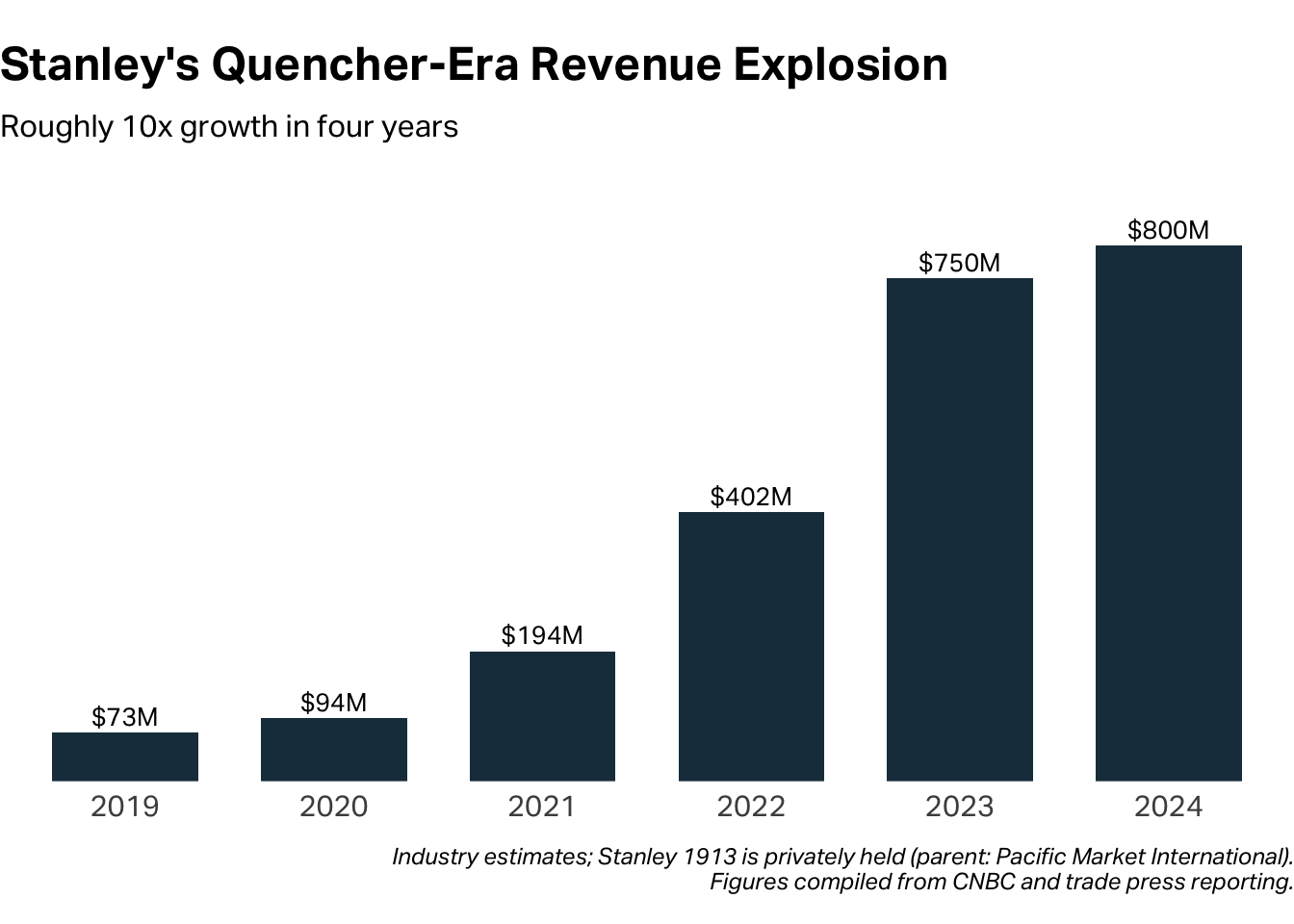
For over a century, Stanley sold rugged steel vacuum bottles to construction workers, hunters, and campers. The Quencher was an experiment and was far from the company’s business priorities. In fact, in 2017 Stanley planned to discontinue it. The cup that would soon make hundreds of millions of dollars was discovered while sitting on a clearance rack in Utah. That’s where Ashlee LeSueur, a mom and author of a shopping blog called The Buy Guide, found it. She loved it, told her followers. They went nuts. The rest is history.
What happened that suddenly made a vacuum-insulated steel cup get hired for millions of jobs? To answer this question, let’s frame it as a value proposition.
Value Propositions
Value propositions help managers identify and deliver the value that will get a product hired by a customer. They sit inside the first step of the value delivery system—choosing the value—and they have three components: a target, a benefit, and a price.
Target audience
All customers are not created equal. A construction worker in Detroit might have very different needs and preferences from those of a college student in Los Angeles. Good value propositions have a clear audience in mind. They don’t try to be everything to everyone. They try to get hired by a specific customer.
Stanley’s old target was outdoor enthusiasts and tradespeople. The new target—the one that printed all the new-found profit—shifted to active young consumers (skewing female) who are concerned about hydration but not at the expense of personal style. Stanley fondly calls them Quencher Women. Demographically, the audience shifted from male to female, and old to young. Psychographically, it shifted from utilitarian to lifestyle. The new crowd includes mom influencers, Bachelor Nation, and the #WaterTok faithful. (Yes, there is a corner of the internet devoted to romanticizing hydration, and it has hundreds of millions of views. What a time to be alive!)
Benefit
To understand the role of benefits in a value proposition, it’s helpful to first understand needs. Successful value propositions satisfy the needs of a specific target audience in a manner that is perceived as superior to alternative options (relative to a specific price point, which we’ll get to in a minute).
Alternatives are an important consideration when understanding what is deemed to be a superior value for the price. It’s not always the obvious rivals in the category. Years ago, the management of Gumout, an automotive engine-cleaning brand, wanted to understand which competitive products mechanics were using when they didn’t use Gumout. They were surprised to learn that the product stealing their business was none other than a 2-liter bottle of Coca-Cola. Mechanics would soak dirty parts in Coke overnight, then rinse them off with water in the morning. The phosphoric acid in Coke did the job perfectly, and it was much cheaper than a bottle of Gumout—a textbook substitute. The lesson is that “superior” is measured against whatever the customer would otherwise hire to get the job done, not against a tidy list of category competitors.
Let’s consider the needs a Stanley Quencher might address for Quencher Women:
- The need to stay hydrated all day without constantly stopping to refill a small water bottle
- The need for an on-the-go travel mug that actually fits into a standard car cup holder (she’s busy)
- The need for refreshingly cool beverage temperatures throughout the day
- The need for the durability that can withstand an active lifestyle without being heavy to lug around all day
- The need to seamlessly switch between a straw for sipping ease and spill protection
- The need for a modern accessory that matches personal style
- The need to make sustainable, eco-friendly choices that are good for the planet
The last need is an interesting one. Stanley describes the eco-friendly dimension as “Built for Life.” While Quencher Women would probably tell you that this influences their purchase behavior, the reality might not align perfectly. In the same way, there is a need that is not defined above but may be part of their choice: belonging. The viral success of Stanley has led many of these consumers to have a need to avoid FOMO (fear of missing out).
So, the need hints at the job(s) to be done. The benefit is the specific, distinctive value the customer actually receives—the reason the product gets hired.
The classic rookie mistake is to confuse a feature with a benefit. A feature is what the offering is: “double-walled steel, 40 ounces, fits a car cup holder.” A benefit is what the customer gets out of that feature. Nobody ever loved a cup for its wall count; they love what the wall count does for them—a drink that’s still cold at 4 p.m. Features are the how; benefits are the why it matters.
Benefits come in three generic forms, and the strongest value propositions often deliver more than one.
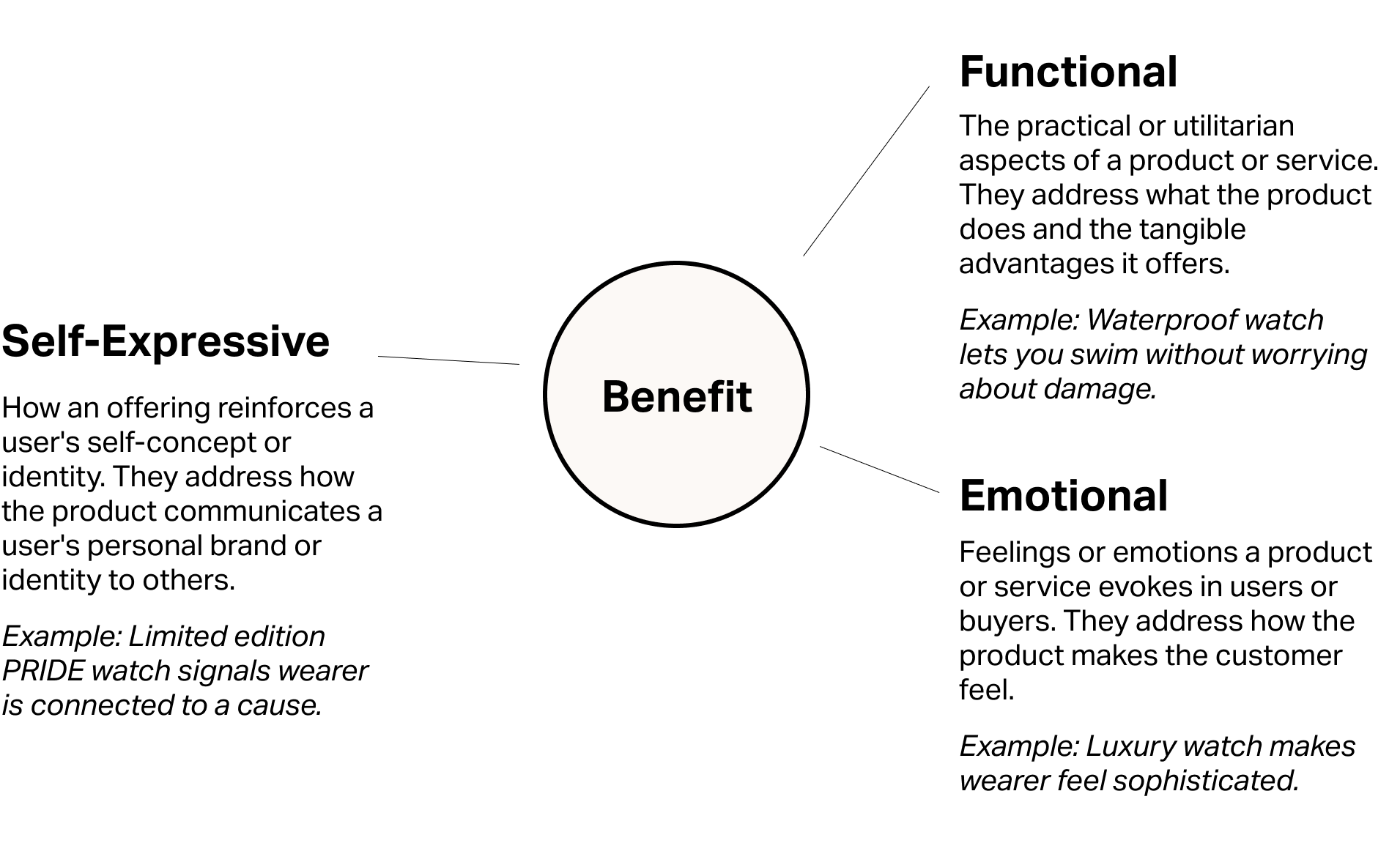
Functional benefits are the practical, tangible payoffs—the offering doing its literal job. For the Quencher, these answer the bulk of the need list: it holds enough water to get her through the day (need 1), fits the cup holder (need 2), keeps the drink cold (need 3), survives an active life without weighing her down (need 4), and switches between sip and spill-proof (need 5). This is real value, but notice it’s also the most copyable value. Any competent competitor can build an insulated cup that does these things—and plenty did.
Emotional benefits are about how the offering makes the customer feel. Here’s where the Quencher pulls away from a generic bottle. Carrying the cup everyone’s talking about feels good. It scratches the belonging itch from the need section—you’re part of the moment, not the lone holdout watching everyone else’s #WaterTok. The emotional benefit is the feeling of being part of a movement.
Self-expressive benefits are about how the offering signals identity to others—what owning it says about you. This is the payoff for the “modern accessory that matches personal style” need (need 6). The specific color, the limited-edition collab, the bow charm clipped to the handle: these let the cup broadcast taste and personality. Two women can own the identical product and still use it to say completely different things about themselves. That’s a self-expressive benefit doing its work.
Stack them up and the pattern is hard to miss. The functional benefits got the Quencher into the consideration set—they’re the price of entry. But the emotional and self-expressive benefits are what got it hired over every other cup that keeps water cold. They’re harder to copy, harder to commoditize, and they map straight onto the needs ordinary water bottles left on the table.
Price
Price is the second half of the value equation, and it’s an integral component of a value proposition. Value is benefits minus price, as judged by the target.
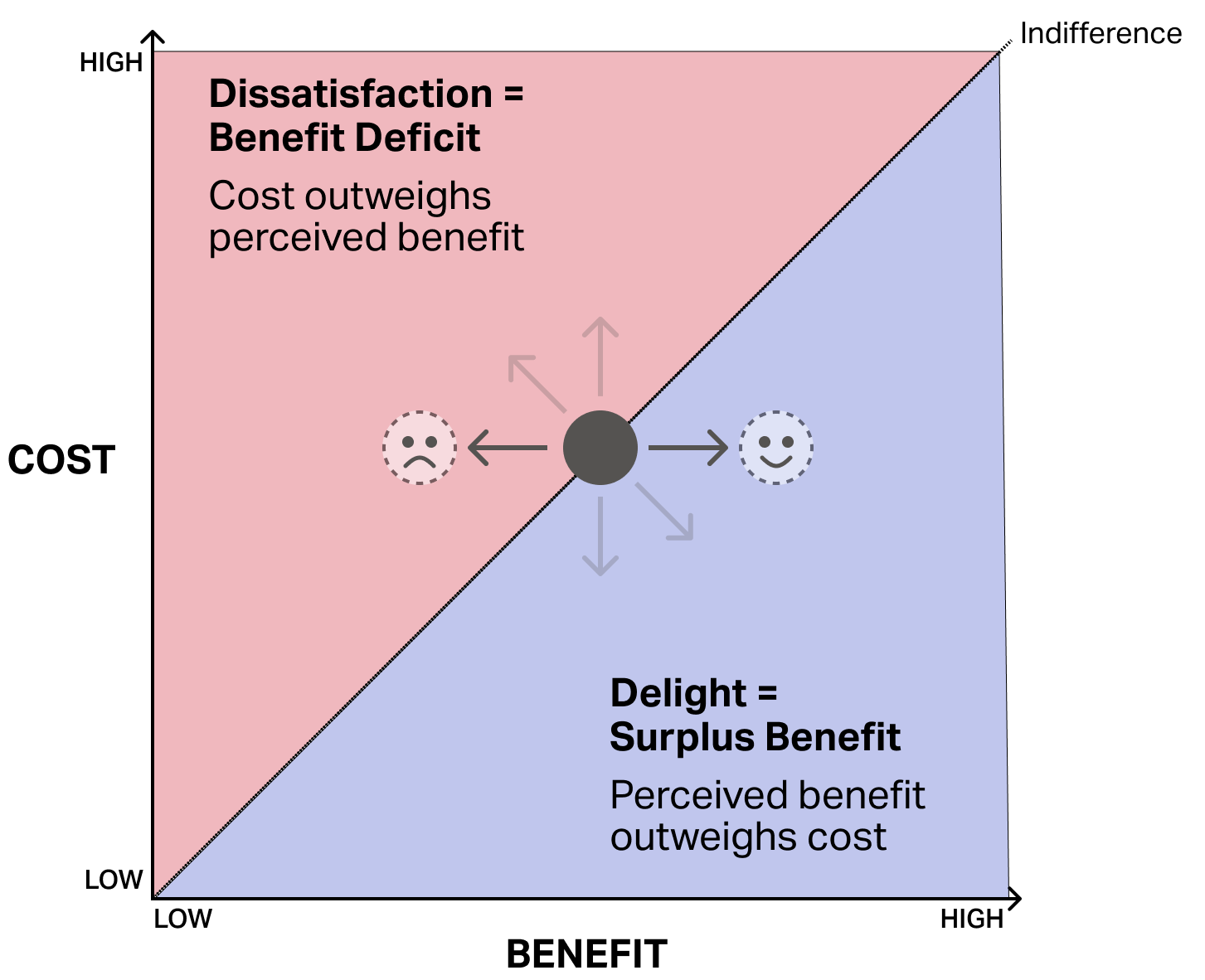
Price and benefit are bound together. The indifference curve is one way of seeing that the optimal price rises and falls with the perceived benefit—a customer who perceives more value will be willing to pay more, and one who perceives less expects to pay less. The Quencher’s price only makes sense in light of the benefit it’s tied to: a basic insulated bottle delivering the functional benefits alone would be overpriced at the Quencher’s number, but the same number is underpriced once the emotional and self-expressive benefits are in the bundle. The resale market makes the point bluntly—some special editions clear at multiples of retail, which is the market telling you the chosen price left value on the table. An Olivia Rodrigo collab Quencher sold out in minutes and now resells for around $10,000. For a cup.
In some instances, it may even make sense to begin choosing the value by selecting a price point for a target audience. This is common in many product categories. IKEA often begins their process by deciding what price a new product must be sold at. From there, they incorporate benefits that address the needs of a specific target audience at a fixed price point. This forces trade-offs and prevents unplanned price inflation.
Putting It All Together
A value proposition is more than a slogan or a tagline, though when the value delivery system is followed with discipline it often informs those communications needs. A value proposition is first and foremost an internal framework that captures, in one place, the value you’ve chosen to deliver. McKinsey summarized the role of a value proposition best:
Customers select a product or a service because they believe it is a superior value. Hence, the heart of running a business is choosing a winning value proposition, then gearing all functions in the business to profitably deliver it. An explicit value promise must be chosen and articulated, reflecting a vigorous understanding of the benefits customers want, their willigness to pay for those benefits, our and competitors’ ability to deliver these benefits, and the cost structure of the industry.
With this thinking in mind, Stanley’s value proposition for the Quencher might look something like this:
For active young consumers who won’t trade style for hydration, the Stanley Quencher delivers all-day cold refreshment and colorful styling that reflects your personal taste at a premium price.
It’s important to realize that the process of developing a value proposition is as much about management as it is about marketing. A good value proposition helps managers make tough choices. It governs how you deliver value to customers over time and what you choose to communicate to them. Done well, it sustains an important connection at the product level between the business and the customer that leads to greater satisfaction and loyalty.
Further Reading
Christensen, C. M., Hall, T., Dillon, K., & Duncan, D. S. (2016). “Know Your Customers’ ‘Jobs to Be Done.’” Harvard Business Review. The most accessible statement of the Jobs to be Done framework from Christensen himself—the milkshake story and all. Start here if JTBD is new to you.
Christensen, C. M., & Raynor, M. E. (2003). The Innovator’s Solution. Harvard Business School Press. Where the “job a customer hires a product to do” language is developed at book length, alongside the broader theory of how products win and lose.
Lanning, M. J., & Michaels, E. G. (1988). “A Business Is a Value Delivery System.” McKinsey Staff Paper No. 41. The paper that coined “value proposition” and laid out the choose–deliver–communicate logic this note is built on. The original staff paper isn’t publicly published, but McKinsey’s Delivering Value to Customers retrospective summarizes its central argument.
Anderson, J. C., Narus, J. A., & van Rossum, W. (2006). “Customer Value Propositions in Business Markets.” Harvard Business Review. A blunt, practical look at what separates a real value proposition from a list of nice-sounding claims—especially the discipline of proving, not just asserting, your points of difference.
Levitt, T. (1960). “Marketing Myopia.” Harvard Business Review. The classic argument that companies fail when they define themselves by what they make rather than the job the customer is trying to get done. The intellectual ancestor of everything in this note.